

When I was nine years old, I asked Santa for world peace.
And also, Legos.
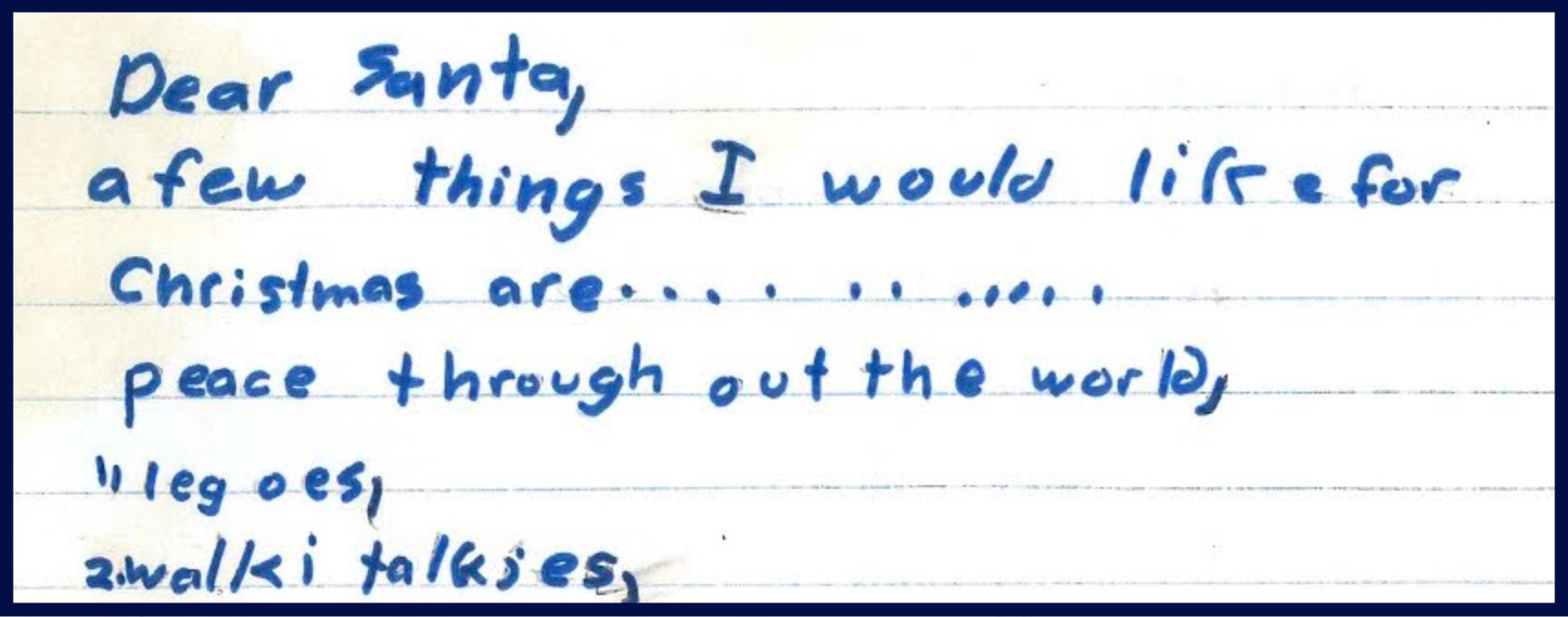

Forty years later, I haven’t changed much.
Still believing. Still building.
“Peace throughout the world” is going to require some exceptional leadership.
I think you might be part of it.
I know what you’re thinking: “Who, me? Leader? I mean, I’m not really a leader. Not, like an actual leader.”
I know, because that’s how I felt.

When I was tapped for my first leadership role, I almost didn’t apply. I was trying to get pregnant. How could I be a leader? I stressed myself out so much that I got strep throat and tried to cancel the interview (my boss wouldn’t let me).
A few years later, when I was named elementary school principal, I cried for three months.
My children were 4, 7, and 9. We had to move from Hong Kong to New York.
I was terrified.
How could I be the leader the organization needed while also being the mother that I wanted to be?
I had precisely zero role models.
I was fortunate. I found two mentors—a work coach and a work therapist—who supported me through my transition. I also found an exceptional community of other women in educational leadership. And my husband has always been my #1 fan.
But what I really wanted was a group of mothers. Mothers in leadership.
After 20 years in education, I left my role as principal to build the community I had been seeking.
That is where this Substack was born.

As I convened small coaching circles, I kept noticing the same pattern: mothers looking around and realizing the grown-ups weren’t doing their jobs. That the people “above” them in leadership were … unprepared. Sometimes downright incompetent.
Mothers thinking, “I could do a better job than that.”
They were all asking some version of the question I had been asking:
“How can I increase my impact as a leader while also being the parent I want to be?”
As we met week after week, I realized we didn’t just have questions, but we had answers, too. Books, apps, poems, memorable metaphors, and lots and lots of stories.
Collectively, we had wisdom. And the more time we spent together, the more we all grew.
Could I bottle the magic?

This Substack is my attempt. I share everything I’ve learned from my own experience and the collective wisdom of the coaching circles, organized around three emerging themes: getting help, saying no, and letting go.
I write twice a week, offering what I’m learning as a gift, hoping it empowers you to step into leadership, or stay in leadership, and help others flourish.
If you’re looking at the leaders around you and thinking, “I could do better than that,” I believe you can, too.
"I feel like I've changed so much in the last three months. I'm more comfortable in my skin. It's like I've shed a version of myself that wasn't working. I didn't throw everything out—just the pieces that didn't fit anymore."
— coaching circle participant
Peace throughout the world is going to take some exceptional leadership.
Who better than us?
🕊️
SAM
Explore the three themes below, or browse this topic index.
1. Getting Help
You can’t do this alone—and you’re not supposed to.
What’s hard about getting help is accepting that you need it. Letting go of the belief that you should be able to do it all yourself.
Leadership requires infrastructure. Not just childcare (though yes, childcare) but a whole ecosystem of support. Domestic support. Professional support. Technological support. Emotional support. The mothers who lead well aren’t the ones who figured out how to do it all. They’re the ones who accept that they can’t.
I write about building a care team, about the tools that save me hours every week, about the systems that keep my household running so I can show up fully for my work and my family.
Start here:
You Need Some Help — on the moment I realized I couldn’t keep going alone
Let’s Talk About Nannies — on the stigma of domestic help and why we need to get over it
The Robot Can Do That — on letting AI handle what AI can handle
More on getting help
2. Saying No
Your capacity is finite. Protect it fiercely.
We’ve been trained our whole lives to be helpful, accommodating, nice. We’ve been rewarded for saying yes. We’ve been punished—socially, professionally, and internally—for saying no.
But here’s the truth: more leadership means more demands on a limited resource, which is you. Something has to give. The question isn’t whether you’ll disappoint someone. It’s how to disappoint the right people.
I write about how to value your time, how to protect your energy, how to create space for what matters most.
Start here:
I Invite You to Disappoint Someone — on the freedom that comes from letting people down
Stop Being Nice With Your Time — on calculating what your time is actually worth
Do Less Stuff — on the radical act of doing less
More on saying no
3. Letting Go
Some things have to break open before you can fly.
Dragonflies molt a dozen times before they’re ready to leave the water. Each time, they break out of an exoskeleton that’s become too small. What once protected them now constrains them.
And then, one day, they crawl out of the water, crack open one last time—and discover they have wings.
Leadership growth works the same way. The habits, beliefs, and identities that got you here eventually stop fitting. You have to break out of them to keep growing. And you’ll do it more than once.
There’s grief in every breaking.
But the greater risk is staying stuck inside a version of yourself you’ve already outgrown.
Start here:
Imaginal Cells — on the messy middle of becoming
Revolutionary Petunia — on blooming anyway, even when the world is on fire
Front of House, Back of House — on the gap between how we appear and how we feel
More on letting go
Thank you for circling back to purpose, and doing so with great authenticity and clarity, as always (as much as you have or had in the moment you wrote this!) I'm excited to see all of this wisdom organized to increase accessibility and community. You go! I'm grateful.
Wonderful Sarah! Loved reading this and it makes me so happy that you are sharing your hard earned wisdom here for other Mothers in Leadership! Kudos & Happy New Year!