

Driving in the dark
Trusting the signs when you can't see what's ahead
I have an excellent sense of direction.
If you were to ask my husband, he’d say: Sarah always knows where she is, and she always knows where she’s going.
That’s not quite true.
When I’m outside in the daylight—whether driving or walking—I have an internal compass. I almost always know which way is north.
But I get tripped up in two places.
Shopping malls. And driving in the dark.
In shopping malls, our GPS switches completely. He moves through a mall the way I move through a highway. He understands the logic of it—what’s next to what, where the food court is, where the bathrooms might be. Meanwhile, I’m standing at the directory trying to figure out which dot is me.
Driving at night, though, we’re both blind.
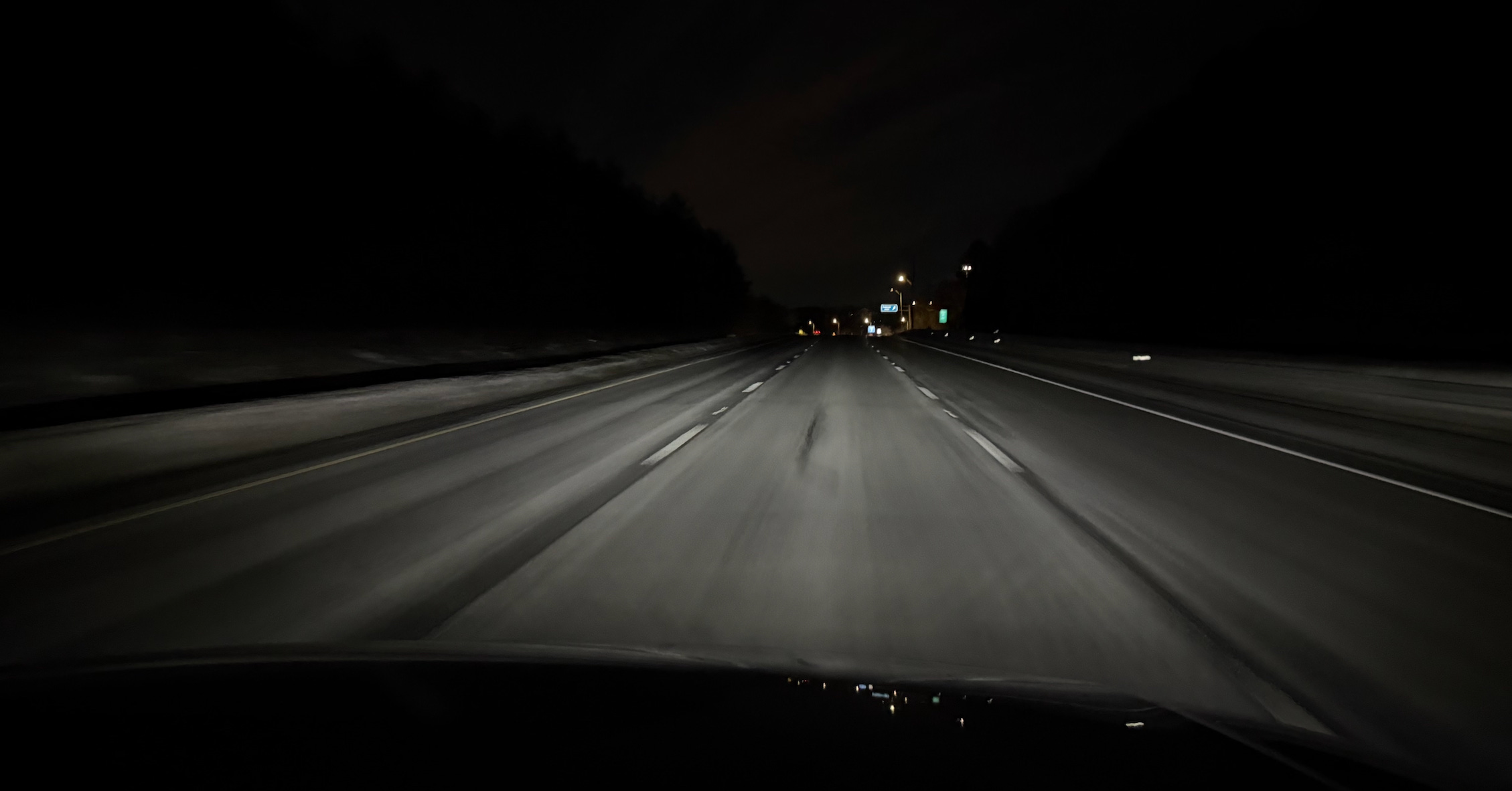
Last week, I was driving home after dark on a road I’d never taken before. No streetlights. No shoulder. Just my headlights cutting a narrow tunnel through the blackness, illuminating maybe fifty feet ahead. The rest was invisible.
In daylight, driving is easy. You can see for miles. You know where the exits are. You can anticipate the curves, adjust in advance, plan your next move.
At night? You can only see as far as your headlights allow.
And you have to keep moving anyway.
This is what transitions feel like.
A friend told me recently she felt like she was in “the wilderness.” Yes. That.
William Bridges describes transitions in three parts: endings, the neutral zone, and new beginnings. I wrote about this in The dragonfly. When things are ending, we can usually see what’s behind us. When something new begins, there’s light on the horizon.
But the neutral zone—that in-between space—is the dark stretch of highway.
Looking back, the path seems clear. The decisions make sense. The story has shape.
Looking forward, you can’t see where you’re going. You can only see the next step.
For mothers in leadership, transitions rarely come one at a time. They overlap. A child starts a new school while you’re starting a new role. A relationship is shifting while a project is ending. You’re grieving something you haven’t fully named while building something you can’t yet see.
And in the middle of all of it, you think you’re supposed to know where you’re going.
But sometimes you don’t.
Sometimes you’re just driving in the dark.
Here’s what I’ve noticed about driving at night.
There are signs. Highway markers, exit numbers, speed limits. They’re reflective on purpose—so that when your light hits them, they shine back. Someone put them there knowing you would need them. Someone who had driven this road before. Kind of like imaginal cells.
Sometimes there are streetlights. A stretch of brightness, a moment of relief. You think: It’s not so dark.
And then you’re back in the narrow beam of your headlights.
The neutral zone doesn’t require us to know the destination. It asks us to stay on the road. To trust the signs. To keep moving forward.
One small stretch at a time.
🕊️
SAM
The neutral zone unknown speaks to me - thank you for naming it.
This makes me think of Steve Jobs quote from 2005 Stanford commencement speech, which I think about all the time - “you can’t connect the dots looking forward; you can only connect them looking backward”